
The Authenticity Advantage
Why Your 2026 Ads Need to Look (A Little) Less Perfect
If your ads still look like mini TV commercials, you’re paying more and getting less. The emerging winners of 2026 are doing something very different: they are leaning hard into simple, human, user‑generated content (UGC) and watching their lead costs drop.
The core idea behind our latest white paper, The Authenticity Advantage, is straightforward: when your prospects feel they’re hearing from a real person instead of a polished brand, every metric in your funnel improves — from scroll‑stopping engagement to booked calls.
2026: The Year “Real” Beats “Perfect.”
In 2026, audiences are drowning in AI‑generated content and “template” ads that all look the same. That has created a quiet revolt in the feeds: people are rewarding what feels real and ignoring everything that smells like a campaign.
Major trend reports now highlight authenticity as the real differentiator, with short, talking‑head videos and rough‑around‑the‑edges clips outperforming carefully scripted, studio‑shot spots. Platforms are responding too; discovery algorithms increasingly favor content that behaves like native, human posts rather than polished brand assets.
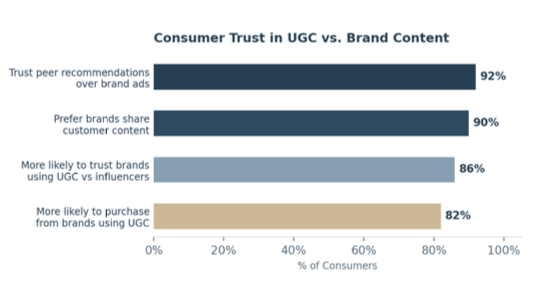
People Trust People, Not Logos
Leads are built on trust, and trust is built between humans, not between a user and a logo. Our research compilation shows that modern buyers overwhelmingly say recommendations from other people feel more believable than anything a brand can say about itself.
On top of that, consumers report they are significantly more likely to see customer‑made content as genuine and to buy from brands that regularly feature real customers in their marketing. In other words, every time you publish a polished studio ad instead of a raw customer story, you’re choosing the weaker trust signal.
Why UGC Crushes Engagement (And Lowers Your Ad Costs)
Higher engagement is not just a vanity metric; it fuels reach, trains the algorithm, and ultimately brings down your cost per lead. Across the data set in our report, UGC consistently delivers a dramatic lift in interactions compared to traditional brand content.
In practical terms, that means a single well‑crafted UGC asset can replace multiple brand posts in your media plan — while simultaneously improving retargeting quality and giving your sales team more warmed‑up leads to work with. When this same style of content is moved into paid campaigns, click‑through rates climb and cost‑per‑click drops, creating a compounding advantage over brands still paying for “TV‑quality” production.
The AI Content Backlash And Why It Matters for Leads
Between 2025 and 2026, AI content creation exploded — but trust in what shows up online went the opposite direction. Multiple studies we reviewed show that a significant share of consumers now doubt the authenticity of online content, and many say they actually pull back when they suspect something was made by AI.
Controlled experiments confirm it: when identical ads are labeled as AI‑made versus human‑made, the AI version is consistently perceived more negatively, especially on emotional connection. UGC sidesteps this entirely because it is, by definition, human, experience‑based, and personal — exactly what buyers are craving in a world of synthetic content.
Ad Fatigue: Why Your “Perfect” Creative Is Getting Scrolled Past
Even before the AI boom, audiences were already tuning out ads. Recent research highlights that the overwhelming majority of people now skip or block traditional advertising formats, and many say there are simply “too many ads” in their feeds.
As a result, click‑through rates fall and costs creep up the longer you hammer people with the same polished assets. UGC‑style creatives, especially the deliberately “ugly” ones that look like regular social posts, slip past these mental ad‑blockers because they feel like recommendations from a peer, not a sales pitch from a brand.
The UGC Market Is Exploding (And Getting More Affordable)
Brands are not guessing on this — they are reallocating budgets. The global market around UGC platforms and campaigns is already measured in the billions of dollars, with aggressive growth projected into the next decade.
At the same time, average UGC campaign costs remain relatively low compared to traditional production, and a growing share of collaborations fall under a few hundred dollars per engagement. For performance‑driven marketers, the ROI math is hard to ignore.
How To Start Shifting Into UGC (Without Burning Your Existing Funnel)
You don’t need to scrap your current ads overnight. A smarter move is to start layering UGC into what already works and let the numbers guide your budget reallocation.
Here are a few low‑friction ways to get started:
Test simple talking‑head videos against your best‑performing polished ads in Meta and TikTok, and watch how click‑through and cost‑per‑lead respond.
Build a lightweight UGC engine by inviting customers to share their stories, reviews, and before‑and‑after clips in exchange for spotlights, bonuses, or small rewards.
Reuse your strongest UGC across the funnel: on landing pages, in email sequences, and in retargeting, not just in organic social posts.
Once you see the lift in engagement and conversion first‑hand, it becomes much easier to justify shifting more budget away from high‑production creative.
Want the Full Dataset and Playbook?
This article only scratches the surface. In The Authenticity Advantage white paper, we walk through:
The detailed stats comparing UGC vs. polished ads on engagement, click‑through, and cost efficiency
Conversion rate lifts across landing pages, product pages, and full lead funnels when UGC is added
A step‑by‑step playbook for turning one 20‑minute phone video into a complete, lead‑generating campaign
If you want the exact numbers, charts, and implementation checklist our clients use to lower their CPA and book more qualified calls, download the full report and get the complete strategy.